Twenty years is a reason to inspect the evidence, not an automatic replacement date.
Should a 20 Year Old Roof Be Replaced in Dayton?
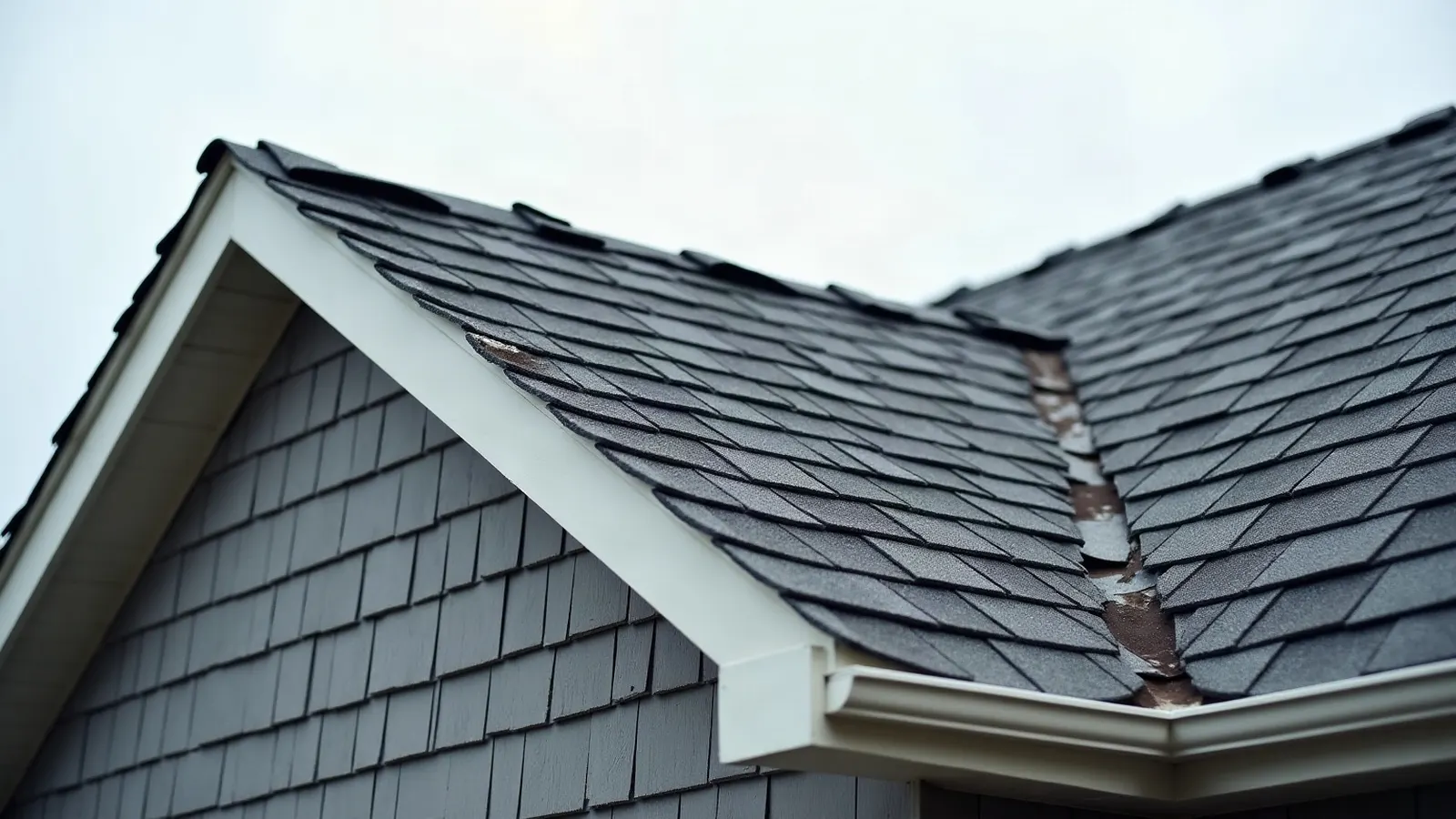
A 20-year-old asphalt roof should be replaced when condition supports it: widespread brittle or missing shingles, recurring leaks, failing flashing, sagging decking or repairs that no longer stay localized. A dry roof with sound shingles may have useful service left. Age triggers a closer look, not an automatic verdict.
Start with installation date, shingle product, leak history and attic evidence. Compare repair scope with Dayton roof replacement cost guide. Do not let age become a same-day deadline.
Asphalt-shingle lifespan by grade
The number is a range, not a deadline. Published materials commonly place asphalt service life around 15–30 years, while premium products may carry longer limited warranties. Warranty term is not promised roof life.
| Shingle grade | Practical age context | What matters at 20 years |
|---|---|---|
| Three-tab | Often discussed in roughly the 15–20-year planning range | At 20, widespread brittleness, tab loss, seal failure and prior repairs deserve close attention |
| Architectural | Often discussed in roughly the 20–30-year planning range | A sound roof may have useful life left, but product, ventilation, exposure and installation can move the outcome |
| Designer or premium | Often positioned for a longer service horizon than basic shingles | Premium material does not protect faulty flashing, poor ventilation or damaged decking |
| Any asphalt grade | Limited-warranty terms may run longer than expected field life | Read exclusions, prorating, transfer and workmanship coverage before treating the printed term as lifespan |
Source: Asphalt Roofing Manufacturers Association consumer guidance and major asphalt-shingle manufacturer limited-warranty documents reviewed September 17, 2026; ranges are planning context, not a prediction for a particular Dayton roof.
Signs replacement is more likely than repair
Widespread shingle failure
Cracking, curling, missing tabs, exposed mat or seal failure across multiple slopes points beyond one repair area. Isolated storm damage is a different question.
Repeated leaks
Leaks returning at different penetrations or valleys can indicate a system near the end of reliable service. Confirm the water path; not every ceiling stain starts in the shingle field.
Soft or sagging decking
Movement, visible sagging or broad deck deterioration calls for more than surface patching. The proposal should price decking units and explain how concealed damage will be approved.
Failing flashings and edges
Trouble at chimneys, sidewalls, skylights, valleys or eaves can spread the scope. Ask whether repair can isolate the detail without damaging surrounding aged shingles.
Repairs cannot be matched
A discontinued shingle or a brittle field may make a small repair conspicuous or damaging. Appearance alone is not always an insurance issue, but repairability matters to the construction decision.
Several problems at once
Age plus leaks plus brittle shingles is stronger evidence than any one fact alone. The more systems involved, the less likely a spot repair resets the risk.
Signs repair may still be reasonable
Damage is isolated
A few wind-damaged shingles or one failed pipe boot can be a repair when the surrounding roof remains flexible, sealed and serviceable.
The water path is known
A confirmed flashing defect with dry decking elsewhere is different from unexplained moisture across the attic. Evidence should define the boundary.
Shingles remain workable
If surrounding shingles can be lifted and resealed without breaking, a qualified contractor may be able to complete a durable localized repair.
The rest of the system is sound
Adequate ventilation, intact flashings, firm decking and no recurring leak pattern support repair. Ask for photos and written limits rather than a verbal assurance.
The 25% rule does not apply in Ohio
The “25% rule” commonly repeated online refers to a Florida Building Code roof-replacement trigger: when more than 25% of a roof section was repaired, replaced or recovered within a 12-month period, broader replacement could be required. Florida changed that rule in 2022 so certain roofs already built or replaced to the 2007 Florida Building Code or later could be repaired without automatically replacing the remaining roof section.
That is Florida law, not an Ohio roof-replacement rule. A Dayton homeowner should not replace a roof because a contractor invokes “the 25% rule” without identifying an actual Ohio or local code provision. Ask the permit authority serving the property what applies to the proposed scope.
Decide what evidence to gather
Establish age and product
Find permits, invoices, closing documents, warranty records or prior-owner information. Record whether the date is documented or merely estimated.
Map the symptoms
List each leak, repair, missing-shingle area, ceiling stain and attic moisture location. Dates and photos are more useful than “the roof is bad.”
Inspect from safe locations
Use ground-level photos and accessible attic observations. Look for daylight, water tracks, damp sheathing and ventilation obstructions. Do not walk a steep, wet or brittle roof.
Request repair and replacement scopes
Ask what can be repaired, why, and for how long the contractor expects that repair to remain serviceable. A replacement quote should still list squares, product, layers, decking, flashing and ventilation.
Compare risk, not fear
Weigh repair cost, remaining condition, leak consequences, ownership horizon and warranty. Then check contractor documents and scope through How to choose a Dayton roofer.
Compare the evidence and the complete scope before replacing
When storm damage changes the question
A sudden wind or hail event creates two separate questions: what construction is needed, and what the policy covers. Do not merge them. Photograph the condition, prevent further damage safely and notify the insurer according to the policy. A contractor may estimate repairs; the insurer makes the coverage decision.
An older roof can still sustain covered storm damage, but age may affect repairability, depreciation or policy settlement. Read Ohio roof insurance claims before signing a contingency agreement or allowing anyone to promise that insurance “will buy the roof.” For material choice after a replacement decision, compare Shingle vs metal roofing.
Frequently asked roof-age questions
Is 20 years old for an asphalt roof?
Yes. Twenty years is within or beyond the planning range often discussed for many asphalt products, so condition deserves serious review. It still does not prove that full replacement is required that day.
Can a 20-year-old roof be repaired?
Sometimes. A localized defect can be repairable when surrounding shingles remain workable and the deck and flashing system are sound. Broad brittleness or repeated leaks make that less likely.
Does a lifetime shingle last a lifetime?
“Lifetime” is a defined limited-warranty term, not a promise that the roof will perform for the owner's lifetime. Prorating, exclusions, installation rules and workmanship remain important.
Does Ohio have the roofing 25% rule?
No. The widely cited 25% replacement trigger is associated with Florida Building Code, and Florida relaxed it in 2022 for qualifying code-compliant roofs. It is not an Ohio replacement rule.
Where are the other short answers?
The Roof replacement FAQ gives one-paragraph answers on cost, size, materials, insurance and project timing.
Ready to compare Dayton roofing quotes?
One short form, several local estimates for an asphalt-shingle roof, no obligation.